Intelligent Mobility & Transportation: Rethinking How the World Moves
Every day, billions of people and goods move across cities, countries, and continents. Transportation connects our lives, powers economies, and shapes how we experience the world.
Yet, the way we move today is becoming increasingly inefficient.
Traffic congestion, long commute times, rising fuel consumption, and growing emissions are placing pressure on transportation systems around the globe. In fact, transportation accounts for nearly 25% of global energy-related CO₂ emissions, making it one of the largest contributors to climate change (International Energy Agency, 2024).
The challenge is no longer just about moving faster. It is about moving smarter, more efficiently, and more sustainably.
A Growing Global Mobility Challenge
As populations grow and urban areas expand, the demand for transportation continues to rise.
Today, more than 4.4 billion people live in urban areas, and this number is expected to increase significantly in the coming decades (World Bank, 2024). With this growth comes increased pressure on roads, public transportation systems, and logistics networks.
Traffic congestion alone has major economic and environmental impacts. In many countries, commuters lose dozens of hours each year sitting in traffic, while delivery systems face delays that affect supply chains and costs.
At the same time, transportation systems remain heavily dependent on fossil fuels, contributing to air pollution and environmental degradation.
Improving mobility is no longer just about convenience. It is essential for economic efficiency, environmental sustainability, and quality of life.
How the World Is Rethinking Transportation
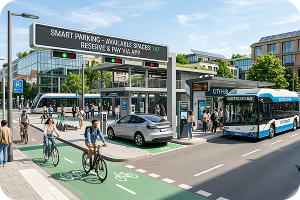
Around the world, governments, companies, and innovators are reimagining how transportation systems work.
Efforts are focused on making movement more efficient, reducing congestion, and lowering emissions. Public transportation systems are being expanded and modernized, while investments in electric vehicles and alternative fuels are helping reduce reliance on fossil fuels.
Logistics and supply chains are also becoming more advanced, using digital tools to optimize routes, reduce delivery times, and improve overall efficiency.
In many regions, transportation is being viewed as a connected system rather than isolated parts, bringing together vehicles, infrastructure, and data to create smarter, more integrated mobility networks.
Technology Driving Intelligent Mobility
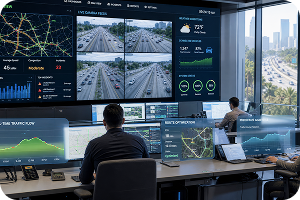
Technology is at the center of transforming how the world moves.
Real-time data and sensors are helping monitor traffic patterns, detect congestion, and adjust traffic signals to improve flow. Navigation systems now use live data to suggest faster and more efficient routes.
Artificial intelligence is being used to predict traffic conditions, optimize transportation networks, and improve logistics planning. Connected vehicles are beginning to communicate with infrastructure and with each other, creating safer and more coordinated movement on the roads.
Electric vehicles are also playing a key role in reducing emissions, while smart charging systems help manage energy demand more efficiently.
Together, these technologies are helping create transportation systems that are more efficient, more responsive, and more sustainable.
Preparing Our Children Today to Solve the Challenges of Tomorrow
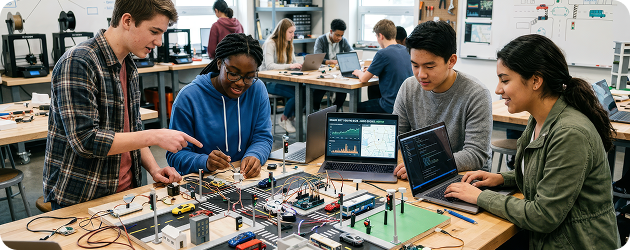
Many children and young people experience transportation challenges every day, from long commutes to traffic congestion, but often only understand them at a surface level. They rarely have the opportunity to explore how these systems work or how they can be improved.
Through initiatives like the Brilliant Global Smart Cities Competition (BGC), students move beyond observation and into action. In the Intelligent Mobility & Transportation pillar, students identify real-world mobility challenges, analyze how transportation systems function, and design and build solutions using data, sensors, and smart technologies.
They explore how traffic flows, how routing decisions are made, and how technology can improve the movement of people and goods. By working through these challenges, students gain a deeper understanding of how mobility impacts everyday life and how innovation can create better systems.
Experiences like this help students think critically, solve complex problems, and see how technology can be used to improve the world around them.
Because the students in today’s classrooms will shape the solutions our world depends on tomorrow.
Sources
International Energy Agency (IEA) – Transport and Energy (https://www.iea.org/topics/transport)
World Bank – Urban Development Overview (https://www.worldbank.org/en/topic/urbandevelopment)
United Nations – Sustainable Transport (https://www.un.org/sustainabledevelopment/transport/)
McKinsey & Company – Future of Mobility (https://www.mckinsey.com)