Protecting the World’s Most Essential Resource
Water touches every part of our lives. It supports our health, grows our food, powers industries, and sustains ecosystems. Yet today, access to clean and reliable water is becoming one of the most urgent challenges facing the world.
More than 2 billion people still lack access to safely managed drinking water, and nearly half of the global population experiences severe water scarcity for at least part of the year (United Nations, 2024).
This is not just a resource issue. It affects public health, food systems, economic stability, and the resilience of entire communities.
A Growing Global Water Challenge
Across the world, water systems are under increasing pressure. Climate change, population growth, and rising demand are all contributing to the strain on freshwater resources.
Today, around 4 billion people experience severe water scarcity at least one month each year, a number that continues to grow (UNICEF, 2024). In some regions, prolonged droughts are becoming more common, while others are facing more frequent and intense flooding.
At the same time, water loss remains a major issue. Large volumes of treated water are lost each year due to leakage, inefficient infrastructure, and poor management. These losses not only waste resources but also increase the cost and complexity of delivering water where it is needed most.
Water is no longer just an environmental concern. It is now at the center of the global climate challenge.
How the World Is Responding
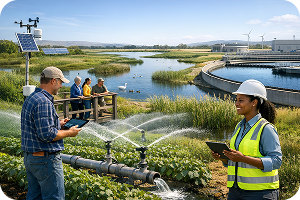
Around the world, governments, organizations, and communities are taking steps to better manage water and build resilience.
Efforts range from improving infrastructure and reducing water loss to restoring natural ecosystems such as wetlands, rivers, and watersheds. In agriculture, which accounts for the largest share of global water use, more efficient irrigation systems are helping conserve water while maintaining productivity.
Many regions are also investing in water reuse and recycling systems, turning wastewater into a valuable resource. Desalination technologies are expanding access to water in areas with limited freshwater supplies.
At the same time, stronger policies and global collaboration are helping ensure that water is managed more sustainably across regions and communities.
Technology Driving Water and Climate Resilience
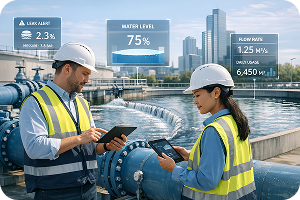
Technology is playing a key role in helping the world better understand and manage water.
Sensors and monitoring systems are now used to track water quality, detect leaks, and measure usage in real time. Data and predictive tools are helping organizations anticipate droughts, manage supply, and respond more effectively to changing conditions.
Satellite technology is also providing a global view of water systems, helping scientists track groundwater levels, glacier melt, and shifts in rainfall patterns.
Innovations such as smart irrigation, water recycling systems, and climate-resilient infrastructure are helping communities use water more efficiently and adapt to both scarcity and extreme weather.
Together, these technologies are helping build more resilient systems that can respond to the challenges of a changing climate.
Preparing Our Children Today to Solve the Challenges of Tomorrow
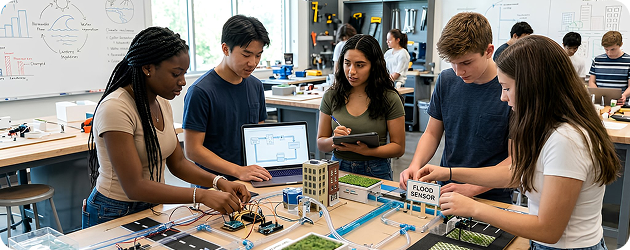
Many children and young people learn about water, environmental, and climate challenges mainly through textbooks. While this builds awareness, it often does not give them the opportunity to fully explore these issues or understand how to solve them in real-world contexts.
Through initiatives like the Brilliant Global Smart Cities Competition (BGC), students move beyond theory and step into real problem-solving. In the Water, Environment & Climate Resilience pillar, students identify real-world challenges, analyze how water systems and environmental factors interact, and design and build solutions using data, sensors, and smart technologies.
They are not just learning about sustainability, they are applying it. They explore how water flows through systems, where inefficiencies exist, and how technology can improve resilience in communities facing real environmental pressures.
Experiences like this help students think critically, experiment with ideas, and gain a deeper understanding of how innovation can support a more sustainable and resilient world.
Because the students in today’s classrooms will shape the solutions our world depends on tomorrow.
Sources
United Nations – Water and Climate Change (https://www.un.org/en/climatechange/science/climate-issues/water)
UNICEF – Water Scarcity (https://www.unicef.org/wash/water-scarcity)
World Health Organization (WHO) & UNICEF – Progress on Drinking Water, Sanitation and Hygiene (https://www.who.int)
World Bank – Water Overview (https://www.worldbank.org/en/topic/water)